

I have written to WNC to place on record my objection to the proposed Solar ‘Farm’ at Yardley Gobion / Potterspury
Shivesh Seedhar 31 August 2025
West Northamptonshire Council
Planning Department
The Forum
Moat Lane
Towcester
Northants
NN12 6AD
Dear Mr Seedhar
Objection to Planning Application 2025/2767/MAF – Proposed Solar Farm near Yardley Gobion
I strongly OBJECT the above proposal and request that this is sent to Committee with a recommendation for REFUSAL for these reasons.
Non Compliance to Planning Policy
West Northants Joint Core Strategy (WNJCS) Policy SA gives a general presumption in favour of sustainable development which “improve the economic, social and environmental conditions for the area.” This application reduces productive farmland thereby impacting on the economic wellbeing of the district against Policy SA. The need to replace that lost food production from other sources has an environmental impact. The loss of bio diversity from the land, the industrialisation of our fields, the increased flood risk and loss of green space all have a damaging environmental impact and are contrary to Policy SA.
WNJSC Policy S10 Sustainable Development Principles has many parts, this application is contrary to many of them:-
S10 – Part C – Make use of sustainably sourced materials
The major supplier of solar panels is China holding more than 80% of the global market supply. They have capacity to build more panels than the need for domestic Chinese demand. There have been many reports raising concerns about the working conditions and slave labour from those employed in their manufacture. In no way can these proposals be deemed to be sustainably sourced and thus are contrary to policy SA( c )
If the council is minded to agree to this we need a condition that the applicant can certify that every panel manufactured has not had forced labour or other practices and conditions that would be illegal in the UK.
S10 – Part H – Maximise water efficiency and promote sustainable drainage
This proposal covers acres of fields with glass. The drainage of the fields will be changed with large areas remaining dry and other areas taking a lot of water running off the glass panels.
The drainage report by the applicant more or less says there is nothing to see here and will drain into the Dogsmouth Brook. This brook has been subject to substantial flood and water modelling in relation to the Furtho Pit warehouse proposal.
I wish to know has the cumulative effect of another proposed development adding pressure to this water course and downstream flood area been modelled. I can see no evidence of it in the documents provided.
The applicant is assuming that local drainage is sufficient – it is not. At present there are issues with localised flooding in Church End caused by water run off and down the hill into the dip.
The local ditch network has not been adequately maintained for decades, there have been incidents within Yardley Gobion with water run off from the fields exacerbated by the ditches being blocked.
The applicant had not assessed this nor provided any remedy.
S10 – Part I – Protect, conserve and enhance the natural and built environment and heritage assets and their settings.
This proposal damages the natural environment and does not enhance or conserve it. Furthermore the Furtho Church is a listed structure and is impacted negatively by this development.
S10 – Part J – Promote the creating of green infrastructure networks, enhance biodiversity and reduce the fragmentation of habitats
These fields are a mix of Grade 2 and Grade 3b land classified as Very Good and Moderate Quality land. They have been used every year for growing of food stock every year that I can recall. The loss of 77 hectares of this quality land should be resisted.
Foxes, badgers, deer and many birds skylarks, red kites, etc are regularly seen in and around these fields. There will be a loss of habitat which no amount of artificial relocation will mitigate or reproduce successfully when compared to the natural way and leaving these fields in agricultural use.
S10 – Part K – Minimise pollution from noise, air and run off.
The proposed panels will increase the water run off potentially causing flooding issues in Church End Potterspury. Run off from these fields is an issue now. Reducing the capacity of these fields to absorb water will exacerbate that.
The South Northants Local Plan Part 2 (LPP2) has general design principles which this proposal violates.
Policies SS2 1a and 1b
- maintains the individual identity of towns and villages and their distinct parts, does not result in physical coalescence that would harm this identity and does not result in the unacceptable loss of undeveloped land, open spaces and locally important views of particular significance to the form and character of a settlement; and
2. uses a design-led approach to demonstrate compatibility and integration with its surroundings and the distinctive local character of the area in terms of type, scale, massing, siting, form, design, materials and details;
These solar panels sit in the green wedge between Potterspury and Yardley Gobion. This industrialisation of the countryside will merge these villages contrary to Part 1a. It is impossible to argue that gleaming glass motorised structures are compatible with the local open countryside and their size, scale and massing all are contrary to Part 1b.
f: will result in a good standard of amenity for its future occupiers in terms of privacy, sunlight, daylight, outlook, natural ventilation, noise, odour and vibration; and will not unacceptably harm the amenity of occupiers and users of neighbouring properties and the area through noise, odour, vibration, overshadowing or result in loss of privacy, sunlight daylight or outlook, unless adequate mitigation measures are proposed and secured;
We do not have sufficient information from the application to judge the adherence to this policy. There will be noise and constant humming from the battery storage. There will be noise, dust and interference with the rural way of life during the construction phase especially to residents of Eastfield Crescent. We don’t now about glint and glare to assess if this impacts on those residents. The proposed mitigation is additional planting, however this will be at least a decade before this matures to provide the mitigation.
The location of the construction compound breaches these policies. Why the applicants have put this as close as possible to residents, approx 90 metres at the closest point, when the have so many other places well away from residential locations I cannot understand.
Should the council be minded to approve this they must reconsider these aspects of the proposal and its proximity to the residents in Eastfield Crescent.
- shows a detailed consideration of ecological impacts, wildlife mitigation and the creation, restoration and enhancement of wildlife corridors to preserve and enhance biodiversity;
There is no need to repeat, but in a similar way to the breach of S10 in Part 1 of the Local Plan, this policy in part 2 is not adhered to.
Traffic Assessment
Local Resident Mr Weeks, a transport professional, has provided a very good review of the Applicant’s Transport Statement.
The review finds the transport assessments farm lacks robust data, underestimates road safety and traffic impacts, omits key details on access and worker trips, and fails to address significant concerns about local road suitability and disruption, making its conclusions unreliable.
These are the main points and concerns expressed:-
- No meaningful consideration of sustainable transport options for construction workers; car use is assumed.
- Local road network, especially Yardley Road and Beech House Drive, is unsuitable for increased HGV traffic due to narrow widths and poor conditions.
- Junctions at A5 and A508 have significant accident records, with inadequate mitigation proposed. No acknowledgement of the fatal accidents on the local road network over which the cable will be taken.
- Site access details are unclear and lack necessary technical evidence, particularly for HGV movements and construction compound access.
- Potential severe traffic disruption from the 10 km grid connection route is not properly assessed.
- Traffic generation estimates lack justification, and there is no data on construction worker trips or existing traffic flows, making impact conclusions unreliable.
Within the applicant’s Traffic Assessment with regards to the A5 there is this single complacent statement
“There will be some localised delay in relation to the grid connection works along the public road. The numbers vehicle numbers associated with such works are not expected to be significant but the works may require some temporary traffic control measures in order to deliver.”
This shows no knowledge of the A5 and complete indifference to the communities living nearby and using this road regularly. A single temporary traffic light can have causing delays in both directions for long stretches. The route through Old Stratford will cause a lot of chaos during construction, there are no short diversion routes to mitigate adequately and residents to the roads off Old Cosgrove Road and Deanshanger Road will be greatly inconvenienced as they cannot access the main A5 London Road. This needs much greater thought and an alternative route.
It is also unclear how the River Great Ouse, at Old Stratford will be crossed. The road bridge is a listed structure, nothing is contained in the assessments to advise how this would be protected during construction.
The A5 is a main route for commuting for many communities in the villages of Cosgrove, Deanshanger, Old Stratford, Potterspury and Towcester, none of which are considered at all by this proposal.
Site Access
The proposed site access is inadequate
1 Yardley Road access lies almost opposite Beech House Drive, almost forming a crossroads which contravenes good design standards. There appears to be no data HGV movements.
A construction access shown onto the A508. I am assuming this is using the existing field entrance that is close to the Yardley Gobion junction. The A508 is a national speed limit road at this point, traffic sitting to turn right and traffic entering and leaving this site will be a hazard both for site visitors and other road users.
The applicant needs to provide additional information as to the proposed compound in this location.
Grid Connection
Although referred to in the traffic assessment the 10km run of cable mostly along the A5 represents a major traffic impediment during construction.
The disruption to Deanshanger, Old Stratford and Stoney Stratford is not acknowledged to at all. Despite the dismissal in the traffic assessment as small local traffic management this needs a lot more planning as the A5 is a major trunk road.
Should there be an incident on the M1 this becomes an unofficial diversion and coupled with any road works would very disruptive during construction. At a minimum there must be an alternative plan as to how to deal with such an event.
Rights of Way
The site is crossed by a number of footpaths. These are well used all year round. The nature of these footpaths will be fundamentally altered by the installation of deer proof 2m fencing, walking will feel more like being in a maze than a walk in open countryside.
Environmental Impact
Industrialising the countryside to produce electricity gives a loss of food production and oxygen from this new use.
A local scientist has calculated this to be approx 560 tonnes per year or 22,400 tonnes of wheat, during the 40 year lifespan of the installation. That loss of wheat per year is sufficient to feed all the residents of Yardley Gobion. Oxygen will be reduced by 350 to 420 tonnes per year, sufficient to support up to 800 people.
These applications are badged as environmentally friendly, supposedly ‘green’ however, there is a significant carbon foot print that must be netted off from the construction materials, glass, steel, cabling, etc and loss of soil carbon. This has bene calculated to be up to 42,000 tonnes CO2 equivalent which must be offset against these claims for driving toward the net zero legal obligations of the UK.
In summary for the 40 year lifespan of this installation
40-Year Impact Summary Table
Value Cumulative food production loss (40 years) 22,400 tonnes
Cumulative oxygen loss (40 years) 15,400 tonnes
Cumulative CO uptake loss by farmland (40 years) 9,800 tonnes CO2e
Total carbon footprint of solar panels (40 years) 44.700 tonnes CO2e
The full calculations are included as Appendix 1.
Conclusion
For all the reasons outlined about I conclude that this proposal should be REFUSED and I asked that WNC Strategic Planning Committee do just that.
Yours sincerely,
Ian A McCord
Ward Councillor for Deanshanger Ward – (Independent)
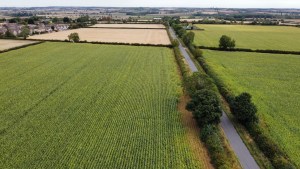
All the green fields here will be industrialised :-
to this

Issues with rain run off from these fields
